



September 2, 2026 – Reading time: 8 minutes
The world was never the same after the popularization of commercial AI applications in 2022 to 2023. It sparked a wave of interest amongst companies, competitors, governments, and the public. Although the research and developments made in the field of artificial intelligence have already existed, the commercialization of the technology became the catalyst for transforming society.
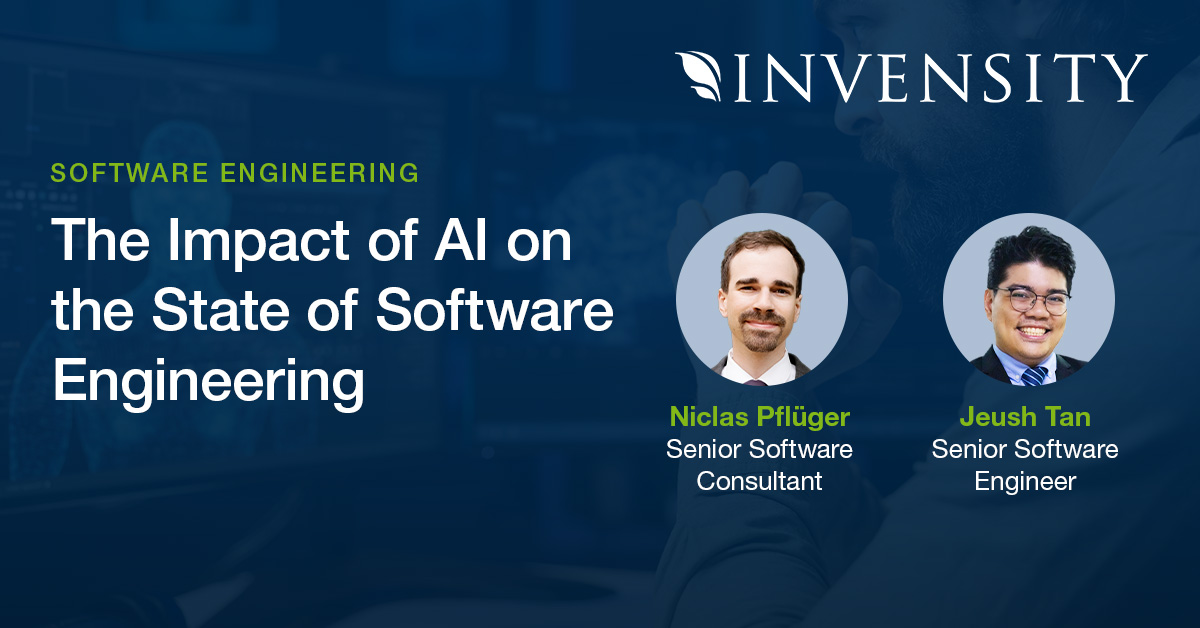
In the case of software developers and engineers, they were now facing a tool that could both supercharge their work but also replace junior developers. This article explores this topic in detail, and features the insights of our Software experts, Senior Software Consultant Niclas Pflüger and Senior Software Engineer Jeush Tan.
The Good
As a technology, AI improves quickly and so does its output and performance. Because of this, tasks and projects can be completed much faster than those done without AI. In a 2025 AI paper by the OECD, they cited studies that showed software developers were 55-56% more efficient at completing their tasks such as writing lines of code.
On the specifics, Senior Software Consultant Niclas Pflüger explains that AI can be thought of as a second brain or coworker that makes work more efficient and leaner. It can be used for requirements analysis, developing several software components and turning ideas into code using a specific programming language. Coding also becomes even more efficient when AI is integrated into the IDE (Integrated Development Environment).
Jeush Tan, Senior Software Engineer, also shares the same sentiment. In his case, he started using AI mainly for prototyping and quality assurance. Over time, he saw that AI can write code well for popular languages like C, Python and Java. Knowing this, he began using AI tools to generate regularly used code.
When Jeush eventually subscribed to an AI application’s higher-tier plan, he discovered even more positives of working with AI. For one, it can parse large amounts of information very well, such as processing large code bases and referencing documentation. Another is accomplishing tasks in parallel like having an AI agent run test scripts while he attends team meetings.
AI may still have room for improvement, but both Niclas and Jeush agree that AI is useful as a tool to complement the existing expertise of software developers and engineers.
The Bad
One consequence of the AI boom is people overestimating how many tasks can now be offloaded to AI. As Niclas says, “Think of your popular AI tool like a Swiss army knife. An application such as Copilot can help you with anything but not with everything. Its output is much better when it’s trained on more specific information.”
He also explains that in software development and engineering, there are some tasks that are better handled by humans. This includes developing software architecture, executing any task that involves handling sensitive data, and reviewing the work AI generates since development teams will still be responsible for outcomes.
Another negative consequence of the AI boom is the layoff of software developers and engineers. In this year alone, several Big Tech companies have laid off their employees to pivot to AI: Microsoft at 4,800, Meta at 8,000, and Oracle at 21,000. Beyond reducing headcount, these layoffs can have broader consequences when senior employees are affected, as teams may lose institutional knowledge and experienced leadership.
The competition for tech jobs also intensifies as tech companies become leaner. Jeush provides his insights about this trend: “Companies typically have pyramid structures. However, with AI, you’re going to see them transform into obelisks. You still need junior developers and engineers to eventually become your seniors, but they’re just not going to be as many.
What’s required for software roles will increase too. Before, it was mainly about knowing how to code and create systems. Now, you’re likely to be asked questions such as ‘How skilled are you in using Claude or ChatGPT?’ or ‘Are you efficient in your use of tokens?’ That’s a reality which aspiring software developers and engineers need to accept.”
Overall, frustration can be felt for those starting out in their software careers or have years of industry experience under their belts.
The Hopeful
AI’s impact on the software industry comes with both good and bad, but such transformation brings with it new opportunities and revelations.
One of these new opportunities is agentic AI. In an interview with U.S. Congressman Ro Khanna at Stanford, Founder-CEO of NVIDIA Jensen Huang explains that AI won’t replace software developers and engineers but boost their productivity. Instead of spending time and effort to execute an idea, the agentic AI takes on this job – giving developers and engineers time to explore more ideas at a larger scale.
Even with the recent layoffs in tech companies, the demand for engineers remain strong. In SignalFire’s 2026 State of Talent Report, engineers were among the least affected by the layoff wave despite tech hiring being down overall. The same report also states that software engineers make up 55% of all tech hiring, up from 46% in 2019.
The last takeaway to be hopeful about is the enduring value of human expertise. In technology consulting, Jeush says that the value consultants bring to projects comes in the form of bringing an outsider’s point of view. By having an external perspective, companies can have more objective ideas to improve their workflows and operations.
AI’s Potential in Software Engineering
With AI reshaping the field of software, engineers and developers must prepare themselves for two things. The first is building fluency with these AI tools quickly enough to stay competitive, and the second is recognizing which responsibilities should still be done by humans such as decision-making and reasoning.
Part of building that fluency starts with the tools closest at hand, including the resources already built into daily workflows.
The INVENSITY chatbot, for example, is INVENSITY’s in-house AI tool currently being developed by Niclas Pflüger and other software and AI experts. “It is designed to act as a second brain for colleagues, handling informational overhead so that colleagues can focus on more important tasks,” says Niclas.
In conclusion, AI can be a powerful tool when it is used smartly and strategically. For software developers and engineers, it is important to communicate with their organizations on what makes sense to automate with AI versus tasks that can only be done by humans.
About the Contributors:
Niclas Pflüger is a Senior Software Consultant who has worked with INVENSITY for more than 10 years. His works spans across several projects and has taken on various roles such as software developer, project manager, senior architect, and design expert.
Jeush Tan is a Senior Software Engineer whose work involves developing software for clients and leading project teams. He is also part of the Manila Office’s Leadership Team, handling the office’s strategic growth and impact for the company.
Author
 Marty Ysaac
Communications Associate

Contributors
- Niclas Pflüger
Senior Software Consultant

- Jeush Tan
Senior Software Engineer

Resources
Learn more
Software Engineering
Artificial Intelligence

Cybersecurity

Artificial Intelligence